U.S. appeals court upholds injunction that blocks Trump's order to create federal voter list
'/> </pattern> </defs> <rect width='1200' height='675' fill='url(%23g)'/> <rect width='1200' height='675' fill='url(%23dots)'/> <rect x='60' y='210' width='6' height='80' fill='%23f5a524'/> <text x='90' y='268' font-size='15' font-weight='900' letter-spacing='5' fill='%23f5a524'>WORLD</text> <g font-family='Inter, Arial, sans-serif'> <text x='60' y='320' font-size='44' font-weight='800' fill='rgba(255,255,255,0.97)' letter-spacing='-0.5'>U.S. appeals court upholds injunction</text><text x='60' y='376' font-size='44' font-weight='800' fill='rgba(255,255,255,0.97)' letter-spacing='-0.5'>that blocks Trump's order to create</text><text x='60' y='432' font-size='44' font-weight='800' fill='rgba(255,255,255,0.97)' letter-spacing='-0.5'>federal voter list…</text> <text x='60' y='620' font-size='14' font-weight='700' letter-spacing='3' fill='rgba(255,255,255,0.7)'>THE HINDU · NEWSEZE</text> </g> </svg>)
Donald Trump issued an executive order for the director of U.S. Citizenship and Immigration Services and the commissioner of the Social Security Administration to create a “state citizenship list” of eligible voters
Sourcing & attribution. Newseze provides AI-curated summaries, narrative framing, and editorial analysis. The underlying reporting was contributed by The Hindu; tap “Open original source” above to read their full reporting and support the contributing newsroom directly.
Newseze's algorithm reads the story and answers your question — calmly, factually, with source attribution. No comments, no flame wars — just answers.
No questions yet. Be the first.
Answers reflect Newseze's editorial framework applied under fair use (17 U.S.C. § 107). Not financial, legal, medical, or tax advice. Hate speech and racial slurs are blocked.
Related stories
Why it mattersThe star is accused of killing Celeste Rivas Hernandez, whose remains were found in a Tesla registered to his address.
 By Chella·3h ago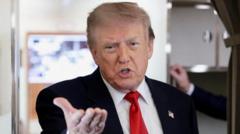
Why it mattersThe US president says "there is a good chance that something could happen", as Iran denies direct talks are taking place.
By Chella·5h ago
Why it mattersFilm studio Universal takes down a high-quality bootleg version of the film, which appeared on X.
By Chella·17h ago
Why it mattersThe rapper takes the witness stand at his trial in Australia where he denies raping a fan in a hotel room.
By Chella·19h ago